
I’ve been reflecting on a classroom experience from my national service in 1989 that still shapes how I think about language and education in Ghana today.
I would value perspectives from educators, policymakers, parents, and the Ghanaian diaspora.
During my national service teaching science in rural Ghana, I experienced a classroom moment that completely changed how I think about language, education, and opportunity
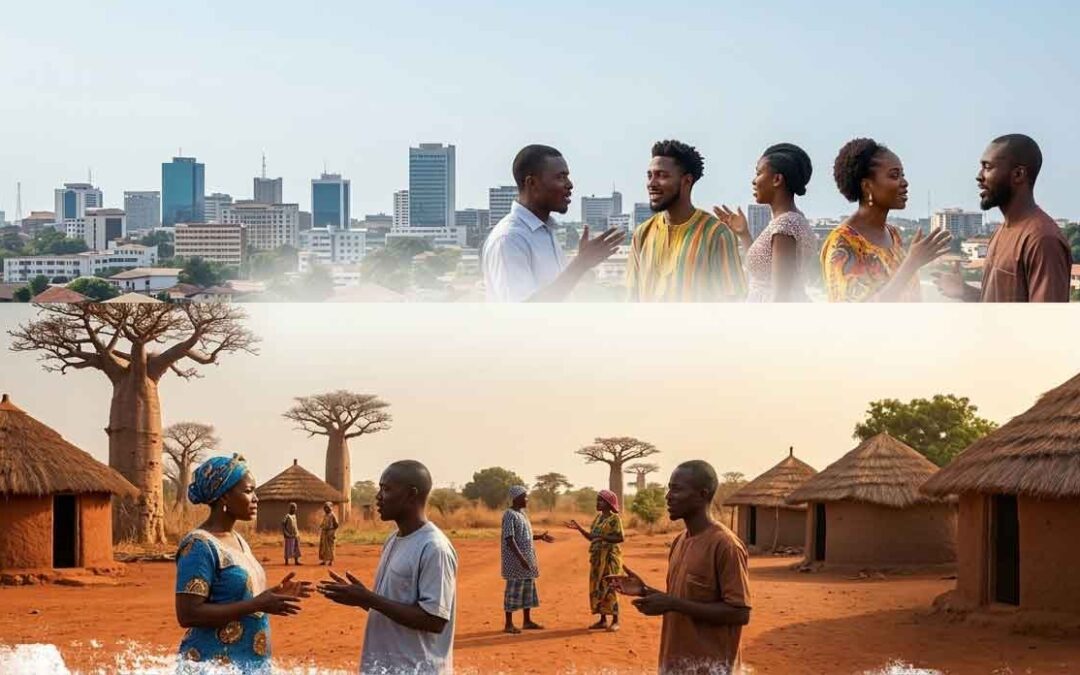
Urban Ghana Is Losing Its Languages. Rural Ghana Is Losing English. Both Are Dangerous.
A grandparent gives a simple instruction in Twi. The child stares blankly. The parent translates it into English.
Three generations stand in the same room — yet two cannot communicate directly. At that instant, more than just words slip away. A cultural bridge between generations begins to disappear.
Scenes like this play out quietly in many Ghanaian homes today. A grandparent speaks Twi or Ga to a young child. The child looks confused and turns to a parent for translation. The parent then repeats the instruction in English. Everyone laughs gently, but what seems like a small everyday interaction reveals something deeper: a growing gap between generations who share the same home but no longer share the same language. People frequently brush off these moments as innocuous or even amusing. But they reveal something far more significant than a simple misunderstanding between a grandparent and a child. Within Ghanaian households, a subtle transformation is occurring in the transmission of language, culture, and identity from one generation to the next. A nation losing its cultural soul. A considerable number of children today use English exclusively as their home language and are unable to communicate in their native tongue. If this trend continues, within a generation, Ghana may raise parents who cannot speak their own language to their children.
This is more than a language issue. It is a cultural one.
When societies abandon their own languages while elevating the colonial language as the only marker of intelligence and success, we begin to see a subtle form of neo-colonialism of the mind.
Yet the challenge is more complex than it first appears.
Many rural communities face the reverse issue. Children speak their local languages fluently but struggle with English—the language of textbooks, higher education, science, and global opportunity.
Urban Ghana is raising children who cannot speak their mother tongue. Rural Ghana is raising children who struggle to master English. One group risks losing its cultural roots. The other risks losing access to global opportunities. If we are not vigilant, Ghana may raise a generation that lacks cultural ties or faces economic hardship.
I experienced this firsthand during my national service in 1989, when I was posted to teach science in Nuamakrom in the Central Region. More than three decades later, the questions raised by that classroom moment remain central to Ghana’s education debate.
I had prepared a lesson on the three states of matter: solids, liquids, and gases.
But the lesson stopped almost immediately. My science class never started.
In that moment I realized my science lesson could not even begin. The students could not spell—or even pronounce—the words “solid,” “liquid,” or “gas.” How could I explain the concept of matter if they did not yet have the language to describe it? How could I move on to explain their characteristics?
Instead of teaching science, I found myself teaching English.
I became so committed to helping those students that I nearly missed my own medical school interview. I felt that the mission could be a life mission. My father repeatedly sent my brother to convince me to move on with my career.
Although the Nuamakrom classroom experience left an impression on me, the issue that has troubled me most over the years has been something else. I have personally encountered many Ghanaian children from different tribes and backgrounds who cannot understand or speak their own local languages. It is particularly noteworthy that some children are exclusively proficient in English—frequently not a fully accurate form—while lacking the ability to converse in the language of their parents or grandparents. We are raising children who cannot speak their mother tongue yet take pride in speaking imperfect English.
But we must ask ourselves: are some parents unintentionally teaching their children that speaking English—even imperfectly—is a status symbol, while speaking their own language is something to hide? Language should be a bridge between generations, not a badge of social status.
This is not simply a language preference. It reflects a deeper shift in cultural identity that Ghana must address thoughtfully through both family practices and education policy.
That experience made one thing clear to me:
Ghana’s language challenge is not simple.
Urban children are losing their mother tongues. Rural children are struggling with English proficiency.
Both issues need to be addressed.
For policymakers, this moment requires careful balance. Ghana’s education system must preserve our linguistic heritage while also ensuring that students gain the English proficiency needed to access higher education, science, technology, and global opportunity. The goal should not be to replace one language with another, but to design an education system that equips Ghanaian children to move confidently between both worlds.
Teachers across Ghana understand this dilemma better than anyone. Each day, they enter classrooms where students might use one language at home, read textbooks in a different language, and are expected to understand challenging concepts in both languages. Teachers often need to think on their feet, switch between languages, translate concepts, and tackle problems that current education policies have not yet solved. Across Ghana, teachers routinely juggle the challenge of helping students grasp their lessons while also readying them for national exams and future opportunities.
Growing up, I was fortunate to experience how multiple institutions supported language learning. In Lartebiokorshie, my local Methodist Church Sunday school taught us the Ga alphabet, which helped me learn to read the language. For a brief period in second and third grade at St. At Anthony’s Preparatory School, I took Ga classes and read children's books in Ga.
Some Church of Pentecost assemblies also encouraged reading in Twi, which further strengthened my ability to read and speak the language.
These experiences show that language preservation does not come from one place alone. It comes from families, schools, and community institutions working together.
Successful multilingual countries like Singapore and India offer useful lessons. They preserved their cultural languages while using English strategically to access global science, technology, and commerce.
Ghana must do the same.
One practical step would be to introduce the additional 5–6 alphabet characters used in Ghanaian languages alongside the standard 26 English letters in early childhood education. Through phonics, children could learn to read both English and their local languages simultaneously. One practical step would be to introduce the additional characters used in Ghanaian languages alongside the standard 26 English letters in early childhood education. For example, in widely spoken Akan (Twi/Fante), only two unique vowels are needed: Ɛɛ (like 'e' in 'set' or 'get') and Ɔɔ (like 'o' in 'all' or 'short'). Ga adds just three (Ɛɛ, Ɔɔ, Ŋŋ), and Ewe a handful more—all on the familiar Latin script.
Many Ghanaian languages add only a few additional characters to the familiar Latin alphabet. Akan adds two unique vowels (Ɛɛ and Ɔɔ). Ga adds one more (Ŋŋ). Ewe includes several additional characters that match specific sounds precisely. These consistent phonetic systems actually make early reading easier than English, where vowels often change sounds depending on context.
As someone who taught all three of my children to read by age four using phonics—before they even started school—I can attest firsthand: English vowels require learning multiple forms and rules (long e, short e, silent e, context shifts like 'o' in 'hot' vs. 'all' vs. 'go'). In our local languages, it is far more intuitive—no guesswork. Each letter reliably matches one primary sound.
We must teach these extra alphabets early. Akan (Twi/Fante) uses only twenty-two letters total—just two unique vowels (Ɛɛ and Ɔɔ) beyond English's 26. Ewe expands to thirty, adding dedicated characters for precise sounds without the confusion of English irregularities. Starting with these in phonics builds stronger, faster foundational literacy in the mother tongue, which then transfers beautifully to English mastery. Children benefit from an intuitive foundation that fosters confident, competent reading skills, ensuring they remain connected to their cultural heritage while preparing for global challenges.
Ga, widely spoken in urban Accra, mirrors this minimalism with just three unique letters beyond English's 26: Ɛɛ (open e, like 'e' in 'bed'), Ɔɔ (open o, like 'o' in 'pot'), and Ŋŋ (like 'ng' in 'sing'). Like Akan's streamlined 22-letter set, Ga's orthography eliminates guesswork—vowels map directly and reliably, with no context-dependent shifts or silent letters. Introducing these shared specials early via phonics would bridge urban language loss and rural English struggles alike, empowering children to read confidently in their mother tongue first, then transfer skills seamlessly to English and even other Ghanaian languages for greater national cohesion.
In my view—and backed by literacy research—these consistent orthographies in Ghanaian languages make initial reading far easier and more intuitive for children. Unlike English, where the same letter 'o' can sound wildly different ('hot,' 'all,' 'go') or 'e' can be long, short, or silent depending on context, Akan vowels like ɛ (always like 'e' in 'set') and ɔ (always like 'o' in 'all') eliminate guesswork. No wondering about silent letters or vowel shifts—children simply map sounds to letters reliably. This builds stronger phonemic awareness and decoding skills early on, creating more confident, efficient readers who then transfer those foundational abilities to English more effectively. We are not just preserving culture; we are creating smarter, more capable learners from the start.
For instance, in Dagbani (widely spoken in Northern Ghana), children never have to puzzle over why the 's' in 'pleasure' suddenly sounds like 'zh'—there is a dedicated letter Ʒ for that exact sound, just as in 'measure.' No exceptions or context rules; the orthography matches the mouth directly.
Even more exciting: Many Ghanaian languages share key special characters like Ɛ ɛ and Ɔ ɔ (the open e and o vowels found in Akan, Ga, Ewe, Dagbani, and beyond). If we introduce these consistently in early phonics—building on the familiar 26 English letters—children could gain foundational skills that transfer across languages. A Dagbani reader might more easily decode basic words in Twi or Ga due to overlapping symbols and predictable sounds. This effort aims to build a multilingual society where children can read in various Ghanaian languages. That shared literacy foundation could strengthen national cohesiveness, reduce ethnic silos, and build a generation that is proudly local yet broadly connected.
Even in Ewe (Volta Region), which uses thirty letters with about 7–8 unique additions (including the shared Ɛɛ and Ɔɔ), the orthography remains consistent and intuitive—no variable vowel rules or absent letters creating confusion. This pattern across our major languages shows the added phonics load is manageable and worthwhile.
Ewe (Èʋegbe), spoken in the Volta Region and beyond, uses thirty letters with about 7–8 unique additions beyond English (including shared Ɛɛ and Ɔɔ, plus Ɖɖ, Ƒƒ, Ɣɣ, Ŋŋ, Ʋʋ, Xx for precise local sounds). These make reading intuitive—no guesswork with variable vowels or absent letters like Q in 'liquid.'
Here are some everyday examples showing how these unique letters bring clarity:
- Ɛɛ (open e, like 'e' in 'bed'): mɛ (inside, pronounced 'meh'), ɛwo (ten, pronounced 'eh-woh')
- Ɔɔ (open o, like 'o' in 'pot'): lɔ (to collect/gather, pronounced 'loh'), wɔ (to do/make, pronounced 'woh')
- Ɖɖ (retroflex/implosive d, soft 'd' farther back): ɖa (to cook, pronounced 'dah' with tongue curled), ɖeká (one, pronounced 'deh-kah')
- Ƒƒ (voiceless bilabial fricative, like blowing out a candle with lips): ƒle (to buy, pronounced 'fleh'), ƒome (family/type, pronounced 'foh-meh')
- Ɣɣ (voiced velar fricative, throaty 'g' or soft 'r'): ɣe (sun, pronounced 'gheh'), ɣletí (moon/month, pronounced 'gheh-lee')
- Ŋŋ (eng, like 'ng' in 'sing'): ŋkɔ (name, pronounced 'ng-koh'), ŋdi (morning, pronounced 'ng-dee')
- Ʋʋ (voiced bilabial fricative, soft lip-rounded 'v'): aʋǔ (dog, pronounced 'ah-voo'), ʋu (to open, pronounced 'voo')
- Xx (voiceless velar fricative, like 'ch' in 'loch'): xa (broom, pronounced 'kha'), xɔ (house/room, pronounced 'kho')
- Ewe is also a tonal language, where pitch on a syllable can change a word's meaning entirely adding precision without extra letters. For example: to (high tone): ear tó (high/rising): mountain tǒ (rising): mortar tò (low): buffalo
- Tones are marked with diacritics like acute (´) for rising/high, grave (`) for low/falling, caron (ˇ) for falling-rising, and circumflex (ˆ) for rising-falling—though not always in everyday writing. This system makes meanings clear once learned, eliminating the context-dependent puzzles of English vowels.
Funny personal note: If I knew what I know now as a child, I would have been very fluent in Ewe by now—those precise sounds would have made learning so much more fun and intuitive!
Here are simple tables comparing minimal additions and consistency across languages (English vs.). Akan, Ga, Ewe): It shows a shared consistency.
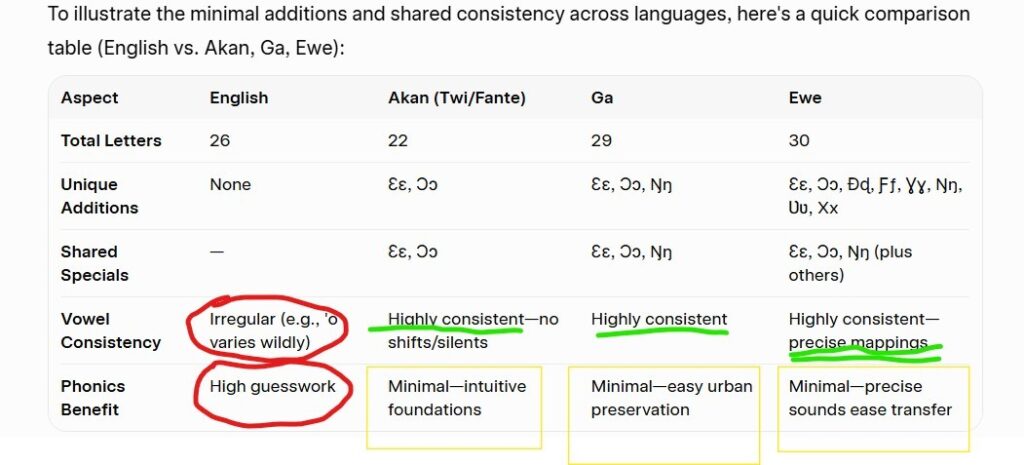
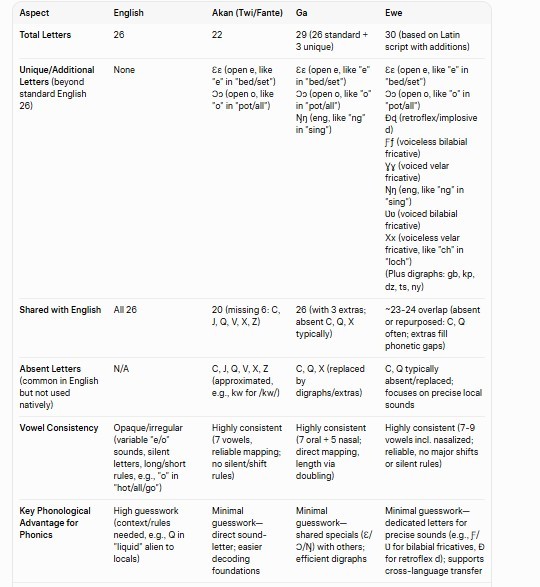
This shared core (especially Ɛɛ and Ɔɔ) means kids could learn a few extras once and read confidently across languages—building a richer, more cohesive multilingual Ghana."
Through simple, fun phonics (songs, blending sounds, picture-word matching), children could learn to read and write both English and their mother tongue simultaneously, with extraordinarily little added time or cost. This builds stronger foundations in both languages, as proven in multilingual education models worldwide and Ghana's own bilingual pilots.
Reflecting further, Akan's unique phonology—missing six English letters (C, J, Q, V, X, Z) and treating R and L as interchangeable variants—may explain why many Twi speakers have historically been teased for 'mixing' R and L. This stereotype has caused real shame and self-doubt for Akan people over generations.
In that Nuamakrom classroom, those children staring at 'liquid' (with its absent 'Q' and tricky sounds) were not lacking ability; they were locked out by a system mismatch. Among them were potential inventors, doctors, engineers, and politicians whose full capacity for national development was stifled because English phonics did not align with their intuitive language foundations. We cannot afford to let such barriers persist. Teaching our extra alphabets early creates intuitive readers, bridges to English without shame, and unleashes true potential."
At the same time, swinging completely toward using local languages for all instruction—without careful planning—could create unfamiliar problems in a country with more than eighty languages. If not implemented strategically, it could unintentionally isolate Ghanaian students from the global economy.
The real solution is balance.
Parents should speak their mother tongues at home. Schools should teach strong English proficiency. English should be taught together with local languages, rather than replacing them.
Our children should be able to speak comfortably with their grandparents in Twi, Ga, Ewe, Dagbani, or Fante and compete confidently in the global economy in English.
If we are not careful, Ghana could raise a generation that cannot speak to their grandparents and cannot compete confidently in the global economy.
We do not have to choose between culture and opportunity.
We must build a system that protects both.
Ghana does not have to choose between cultural identity and global competitiveness.
We can preserve our languages and prepare our children to compete in the global economy — if we pursue a balanced and strategic bilingual education model. A successful nation raises children who can speak to their grandparents in their mother tongue and compete with the world in English.
Ghana now stands at a crucial decision point.
We can either allow our local languages to slowly disappear while chasing English prestige, or we can isolate our children from global opportunity by abandoning English entirely.
Both paths are mistakes.
The real solution is balance.
Our children should be able to speak comfortably with their grandparents in Twi, Ga, Ewe, Dagbani, or Fante and compete confidently in the global economy in English.
If we get this right, we will raise a generation that is culturally grounded and globally competitive.
If we get it wrong, we risk raising children who cannot speak to their grandparents or compete confidently on the world stage. Ghana’s future depends on raising children who know who they are, where they come from, and how to compete confidently in the world.
Do you think Ghana can preserve its local languages while still ensuring our children remain globally competitive?
I would especially welcome perspectives from educators, policymakers, parents, and members of the Ghanaian diaspora.
A Personal Reflection
I say all this not as someone who opposes English or fears global engagement. On the contrary, I read, write, and speak English, Ga and Twi fluently, and I am comfortable communicating in both American and British accents. At the same time I can read both ga and twi languages as well. I have not yet attempted to write full articles in Twi or Ga, and I suspect it would take some effort.
But that is exactly the point.
It is possible to be globally competent in English while remaining rooted in our mother tongues. My own experience demonstrates that multilingual ability is not a barrier to success—it is an advantage. In fact, I am able to communicate complex ideas—including medical concepts—clearly in Twi and Ga when speaking with patients, families, or community members who may not be comfortable with English.
Ghana should be raising millions of children who are just as comfortable speaking Twi, Ga, Ewe, Dagbani, or Fante with their grandparents as they are writing academic papers or conducting business in English.
That is the balance we should strive for.
Dr. Bertha Serwa Ayi, MD, FACP, FIDSA, MBA Medical Doctor | Infectious Disease Specialist
#GhanaEducation #AfricanLanguages #CulturalIdentity #GlobalEducation #GhanaDiaspora
his really got me thinking. We’re losing our languages from both sides, in the cities and in the villages, just in different ways.
In urban Ghana, English is starting to feel like the goal, and many kids understand Ga, Twi, or Ewe but can’t speak them well.
Meanwhile, rural areas, which should preserve these languages, are also slowly losing them through migration and changing lifestyles.
If we’re not intentional, we could lose it from both ends, and that’s a huge loss for who we are.